
Does Surface Wear Mean Loss of Strength?
A 10-Year ICON XHD Test Provides the Answer
Ten years of towing operations leave visible marks on any rope. The critical question, however, is not how worn the rope appears on the surface, but whether that wear has penetrated the load-bearing fibers responsible for its strength.
When a rope manufactured by our team, using the design now offered as TATRAROPES ICON XHD, returned to us after approximately a decade of service, its protective strand covers showed clear signs of abrasion and localized damage. To understand the rope’s true condition, we conducted a detailed structural inspection followed by a destructive breaking strength test.
The findings demonstrated exactly why ICON XHD was engineered with individual protection for every load-bearing strand.
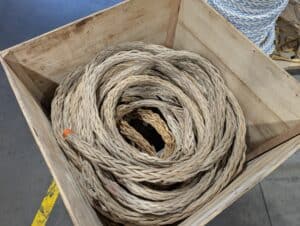
Ten Years in Real Towing Operations
According to available operational records, this rope was used in towing applications for approximately ten years under real working conditions.
The actual service life of any rope depends on numerous factors, including usage intensity, operating practices, environmental conditions, and external influences.
The documented performance of this specific ICON XHD rope demonstrates exceptional durability. Thanks to its advanced construction, it has achieved one of the longest recorded service lives within its category and application, highlighting its reliability in demanding towing operations.
The inspection focused on four key questions:
- How far had visible wear progressed into the rope structure?
- What condition were the load-bearing HMPE fibers in?
- What breaking force would the rope achieve after years of service?
- How would the result compare to the rope’s reference Minimum Breaking Load (MBL)?
Individual Protection for Every Load-Bearing Strand
ICON XHD is a 12-strand HMPE rope in which each load-bearing strand is protected by its own tightly braided cover.
Unlike conventional constructions where protection is limited to the rope’s outer surface, ICON XHD places a protective barrier directly around each structural strand.
In practical terms, this means abrasion, contact with working surfaces, and other mechanical damage affect the protective cover first. Its purpose is to shield the low-twist HMPE fibers that carry the load, limiting the penetration of wear, contamination, and debris into the rope’s critical structure.
The rope examined in this study provided a clear demonstration of this design principle.
What the Inspection Revealed
The protective covers showed significant signs of service wear. Abraded areas and localized surface damage confirmed that the rope had experienced years of demanding operational use.
However, once the protective layers were opened and separated for inspection, a different picture emerged.
In the areas examined, the internal HMPE load-bearing cores showed no corresponding level of damage. Most of the wear remained concentrated within the protective covers themselves.
In other words, the covers had performed exactly as intended, acting as the first line of defense between the operating environment and the fibers responsible for carrying the load.
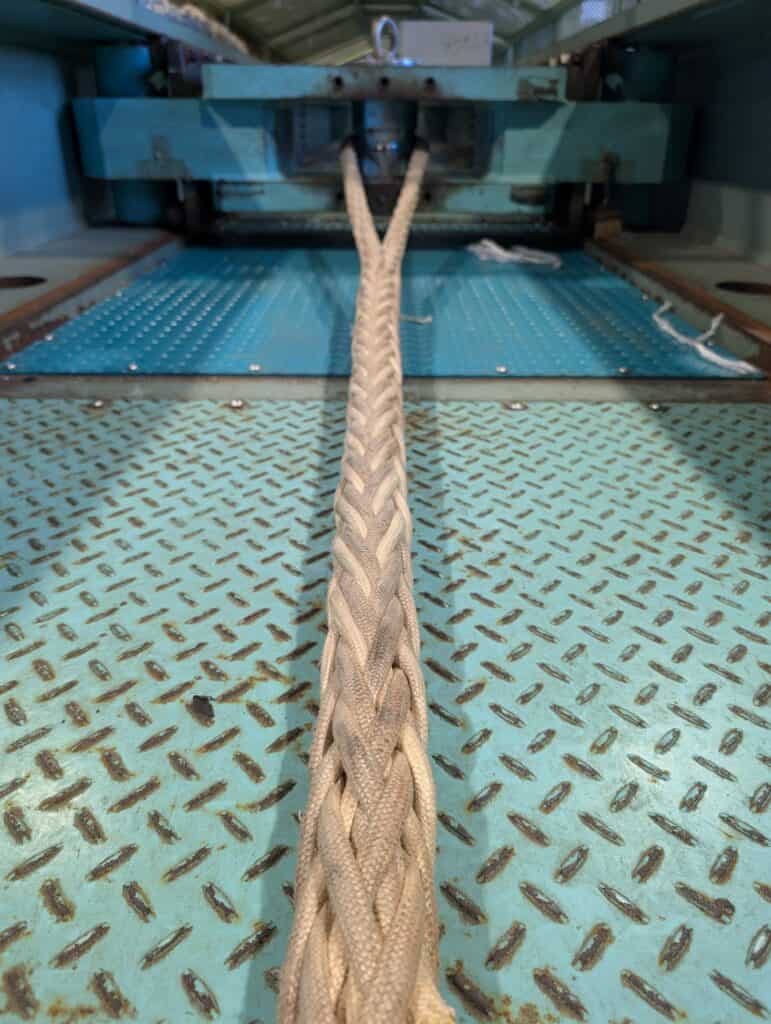
Breaking Strength Within 6% of the Reference MBL
Following the inspection, the rope underwent a destructive tensile test.
The used rope achieved a breaking force that was no more than 6% below the published reference MBL for a rope of the same diameter and configuration.
In practical terms, the tested sample retained at least 94% of the reference minimum breaking strength specified for a new rope after approximately ten years of service.
It is important to interpret this result correctly. Since the rope’s actual breaking strength was not measured before entering service, the test does not prove that the rope lost exactly 6% of its original strength. Rather, it demonstrates that the used rope’s breaking force remained very close to the published reference MBL for a new rope.

Three Key Findings
- The Protective System Continued Working After Years of Use
Visible wear was concentrated primarily in the protective strand covers, while the load-bearing HMPE fibers remained protected in the inspected areas.
- A Damaged Cover Does Not Automatically Mean Equivalent Strength Loss
Surface condition is an important warning indicator, but it does not necessarily reveal the condition of the rope’s internal structure. Service decisions should always be based on a professional inspection of the complete rope construction.
- The ICON XHD Design Limited Wear Transfer to the Load-Bearing Fibers
By protecting each strand individually, ICON XHD creates multiple layers of defense against mechanical damage. The breaking strength test confirmed that the rope maintained strength close to its reference MBL even after prolonged operational use.
What This Means for Rope Users
These results should not be interpreted as proof of a universal ten-year service life for all ICON XHD ropes.
A rope’s condition is influenced by numerous factors, including:
Load intensity and frequency
Surface contact conditions
Bend radius
Winch and drum design
Temperature exposure
Contamination
Maintenance practices
Shock loading and overload events
During routine inspections, particular attention should be paid to:
Areas where the protective cover is completely worn through
Exposed load-bearing fibers
Localized cuts or strand damage
Changes in rope diameter or shape
Hardened, melted, or heat-damaged sections
Contamination that has penetrated the rope structure
Undocumented overload or shock-loading events
If load-bearing fibers become exposed, or if there is any uncertainty regarding rope condition, visual inspection alone is not sufficient. The rope should be removed from service until a professional assessment has been completed.
Accurate service records are equally important. Documentation of operating hours, repairs, damage incidents, and exceptional loading events substantially improves the accuracy of remaining-life assessments.

A Design Principle Validated in Real Service
A single tested sample cannot define the lifespan of an entire product range. Nevertheless, this inspection provided clear evidence supporting the core principle behind ICON XHD:
By protecting every individual strand, external wear can be prevented from reaching the load-bearing HMPE fibers as quickly as in conventional constructions.
After ten years of operation, the protective covers clearly reflected the conditions the rope had endured. The internal inspection and breaking strength test then revealed why those protective layers were there in the first place.
If you need to assess the condition of a used rope and determine whether continued service, repair, or replacement is the best option, contact the TATRAROPES technical team. Professional inspection and testing provide a far more reliable basis for decision-making than age or appearance alone.